
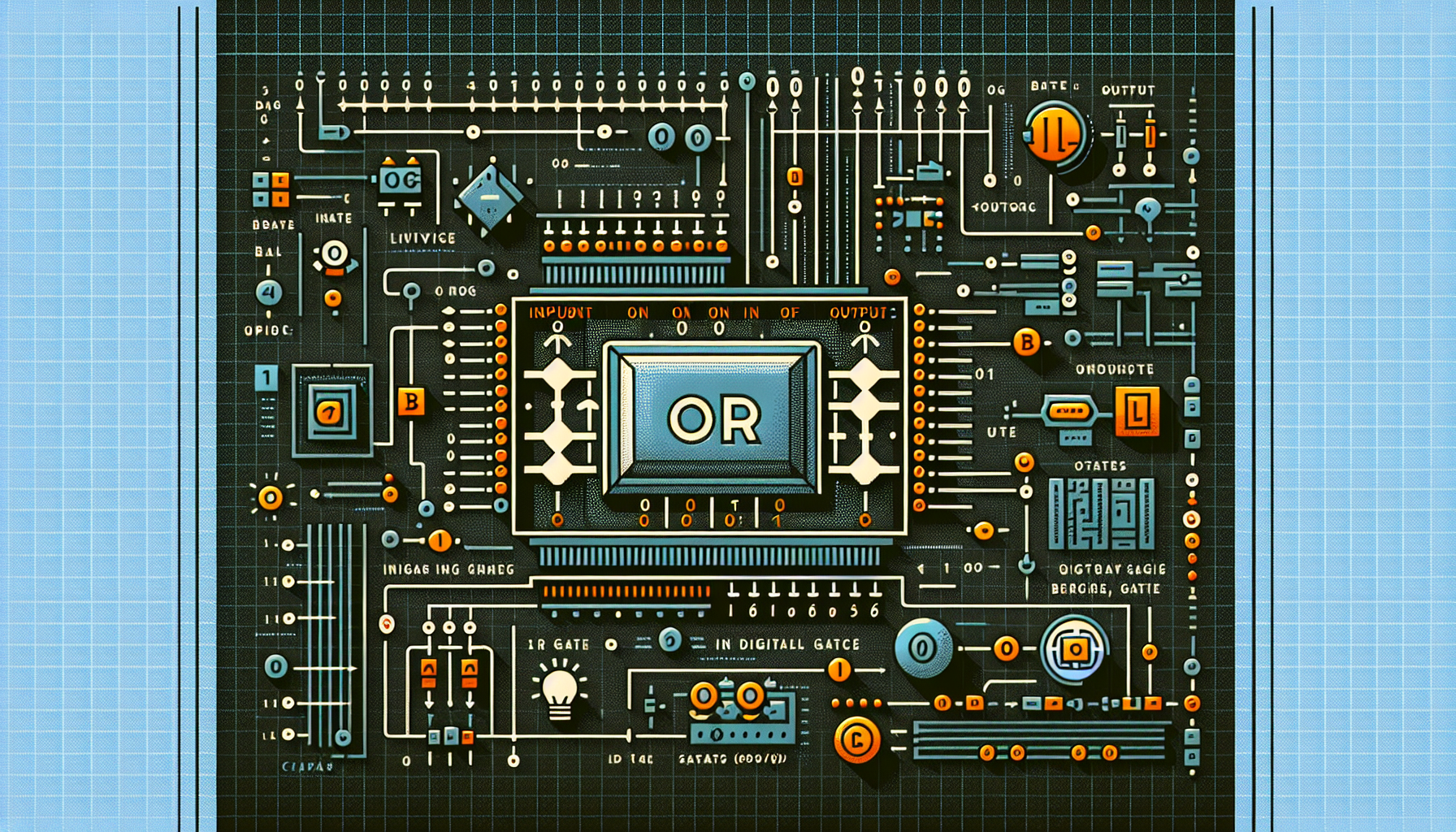

Explore the fundamentals of the digital electronics topic titled “4.1 Logic Gates: OR Gate in Digital Electronics”. This subject is essential for digital devices and enables in understanding logic devices.
This section provides a broad overview:
1. Introduction
In the rapidly evolving domain of digital electronics, logic gates form the foundational building blocks for designing complex digital systems. Among these, the OR gate is one of the fundamental gates used to perform logical disjunction. This gate is pivotal for constructing decision-making circuits, data processing units, and various control systems. Its simplicity and versatility make it essential for students preparing for IT Officer, System Officer, and other digital electronics examinations. In practical applications, the OR gate is extensively integrated into banking automation systems, embedded processor architectures, and IT hardware configurations to facilitate logical operations that determine outcomes based on given input conditions. Understanding the OR gate not only provides insight into digital circuit design but also enhances problem-solving skills vital for technological careers.
2. Core Concept
Subheading: Definition of OR Gate
- Definition
The OR gate is a basic digital logic gate that outputs a high signal (1) when at least one of its inputs is high (1). It produces a low output (0) only when all its inputs are low (0).
- Working Principles
The operation of an OR gate can be summarized by its truth table, which clearly defines the output for all possible input combinations. It employs the logical disjunction operation, meaning the output is true if any input is true. Internally, the OR gate can be implemented using semiconductor devices such as transistors, which switch the output to high upon receiving high input signals.
- Real-life Applications
In everyday digital systems, OR gates are employed to create decision-making circuits, such as emergency alert systems, alarm circuits, and control signals within microcontrollers. They facilitate the combination of multiple conditions, enabling devices to respond appropriately to varied input scenarios.
Subheading: Logical Symbol and Expression
- Symbol
The standard symbol for an OR gate is a curved shape with multiple input lines converging at the left and a single output line on the right, often represented as:
    _______________

   |               \

A--|>OR            )-- Output (Y)

B--|> Gate        /

   |______________/
- Boolean Expression
The logical expression of an OR gate with inputs A and B is written as:
Y = A + B
where “+” denotes the logical OR operation, and A and B are binary variables with values 0 or 1.
Subheading: Truth Table of OR Gate
| Input A | Input B | Output Y |
|---|---|---|
| 0 | 0 | 0 |
| 0 | 1 | 1 |
| 1 | 0 | 1 |
| 1 | 1 | 1 |
This table demonstrates that the output is high if either or both inputs are high, aligning with the logical function of the OR operation.
Subheading: Karnaugh Map (K-map) for OR Gate
AB | 00 | 01 | 11 | 10

Y  |  0 |  1 |  1 |  1
The K-map provides a visual method for simplifying Boolean expressions involving multiple variables, reaffirming that the OR function simplifies to parameters shown in the truth table.
Subheading: Circuit Layout
Input A ----|\

             | OR |---- Output Y

Input B ----|/
In physical circuit design, the OR gate can be implemented using transistor arrangements, diode logic, or integrated circuit chips.
Subheading: Timing Diagram
Input A:  ____-----____-----____

Input B:  ______-----______-----____

Output Y:___-----------___-------___
This waveform illustrates how the output responds instantaneously to changes in input signals, ensuring logical consistency in digital circuits.
3. Diagrams and Visual Aids
- Truth Table: See the table in the Core Concept section.
- Karnaugh Map: Provided above in the K-map section.
- Circuit Layout: ASCII diagram provided in the Circuit Layout section.
- Timing Diagram: Visualized in the Timing Diagram section.
- Conversion Chart: Binary–Decimal–Hexadecimal conversion table below:
| Binary | Decimal | Hexadecimal |
|---|---|---|
| 000 | 0 | 0x0 |
| 001 | 1 | 0x1 |
| 010 | 2 | 0x2 |
| 011 | 3 | 0x3 |
| 100 | 4 | 0x4 |
| 101 | 5 | 0x5 |
| 110 | 6 | 0x6 |
| 111 | 7 | 0x7 |
4. Real-World Applications
- Decision logic in banking automation systems to trigger alerts or permissions when specific conditions are met.
- Microcontroller-based embedded systems where multiple input signals determine an output action.
- Alarm systems in security setups where an alert triggers if any sensor detects intrusion.
- Input validation circuits in digital devices ensuring that at least one required signal is high before activating a process.
- Control panels in IT hardware that activate functions based on multiple input conditions.
5. Important Formulas
- Boolean Equation:
Y = A + B - De Morgan’s Theorem (for dual logic):
(A + B)' = A'B'
(Note: Not directly applicable to OR gate, but essential for understanding logic simplification.)
6. MCQs for Practice
Q1. What is the output of an OR gate when both inputs are 0?

A. 0  ✔️ Correct

B. 1

C. Undefined

D. Cannot be determined
Explanation: The OR gate outputs 0 only when all inputs are 0.
Q2. Which logic operation does an OR gate perform?

A. Conjunction

B. Disjunction  ✔️ Correct

C. Negation

D. Exclusive OR
Explanation: OR gate performs the logical disjunction operation.
Q3. What is the Boolean expression for a two-input OR gate?

A. A · B

B. A + B  ✔️ Correct

C. A' + B'

D. A ⊕ B
Explanation: The OR gate is represented by the '+' symbol in Boolean algebra.
Q4. The symbol for OR gate is represented as:

A. _______________

   |     |     |

   | AND |    |

   |_____|_____|
B. _______________

   |     |     |

   | OR  |    |

   |_____|_____|
C. _____________

   |

   | NOT

   |____________|
D. _________

   |        |

   | XOR    |

   |________|
✔️ Correct: B
Q5. Which of the following is NOT a typical application of an OR gate?

A. Alarm systems

B. Decision-making circuits

C. Arithmetic addition of binary numbers  ✔️ Correct

D. Signal merging in communication systems
Explanation: While OR gates can be part of adder circuits, their primary use is decision logic, not direct arithmetic addition.
7. Frequently Asked Questions (FAQs)
- Q: Why is it called an OR gate?
A: Because it performs the logical OR operation, which outputs true if any input is true. - Q: How many inputs can an OR gate have?
A: Typically, an OR gate can have two or more inputs, with ICs available for multiple-input configurations. - Q: Can an OR gate be used to implement other logic functions?
A: Yes, with appropriate combinations, OR gates can help implement AND, NOT, and other operations through logic circuitry. - Q: What is the main difference between OR and NOR gates?
A: The OR gate outputs high when any input is high, whereas a NOR gate outputs low when any input is high; NOR is the complement of OR. - Q: Is the OR gate digital or analog?
A: The OR gate is a digital logic device, functioning with binary signals representing high (1) or low (0).
8. Summary
- The OR gate is a fundamental digital logic element performing a logical disjunction, outputting high when at least one input is high.
- It is crucial for decision-making processes within digital systems, enabling complex circuit functions.
- Used extensively in banking automation, embedded processors, security systems, and IT hardware.
- Visualizing its truth table, circuit diagram, and timing waveforms aids in understanding its operation.
- Studying Boolean algebra and practical circuit design improves comprehension and implementation.
9. Tags & Keywords
digital electronics, 4.1 Logic Gates: OR Gate in Digital Electronics, logic gates, binary systems, IT officer exam, system officer, banking automation, electronics notes, circuit design
For more detailed study, refer to relevant textbooks,
official technical resources, or trusted educational sites.
Browse more related topics in our [Digital Electronics Archives](https://padhaiguru.in/category/digital-electronics/) for in-depth guides and notes.
Stay updated on digital electronics topics and exam tips using hashtags: #Logic #Gates #Gate #Digital #Electronics
Share your thoughts about this topic in the comments below!
—
For further technical reference, see detailed entries on [Digital electronics fundamentals](https://en.wikipedia.org/wiki/Digital_electronics) and [Fundamental logic gate types](https://en.wikipedia.org/wiki/Logic_gate).
