
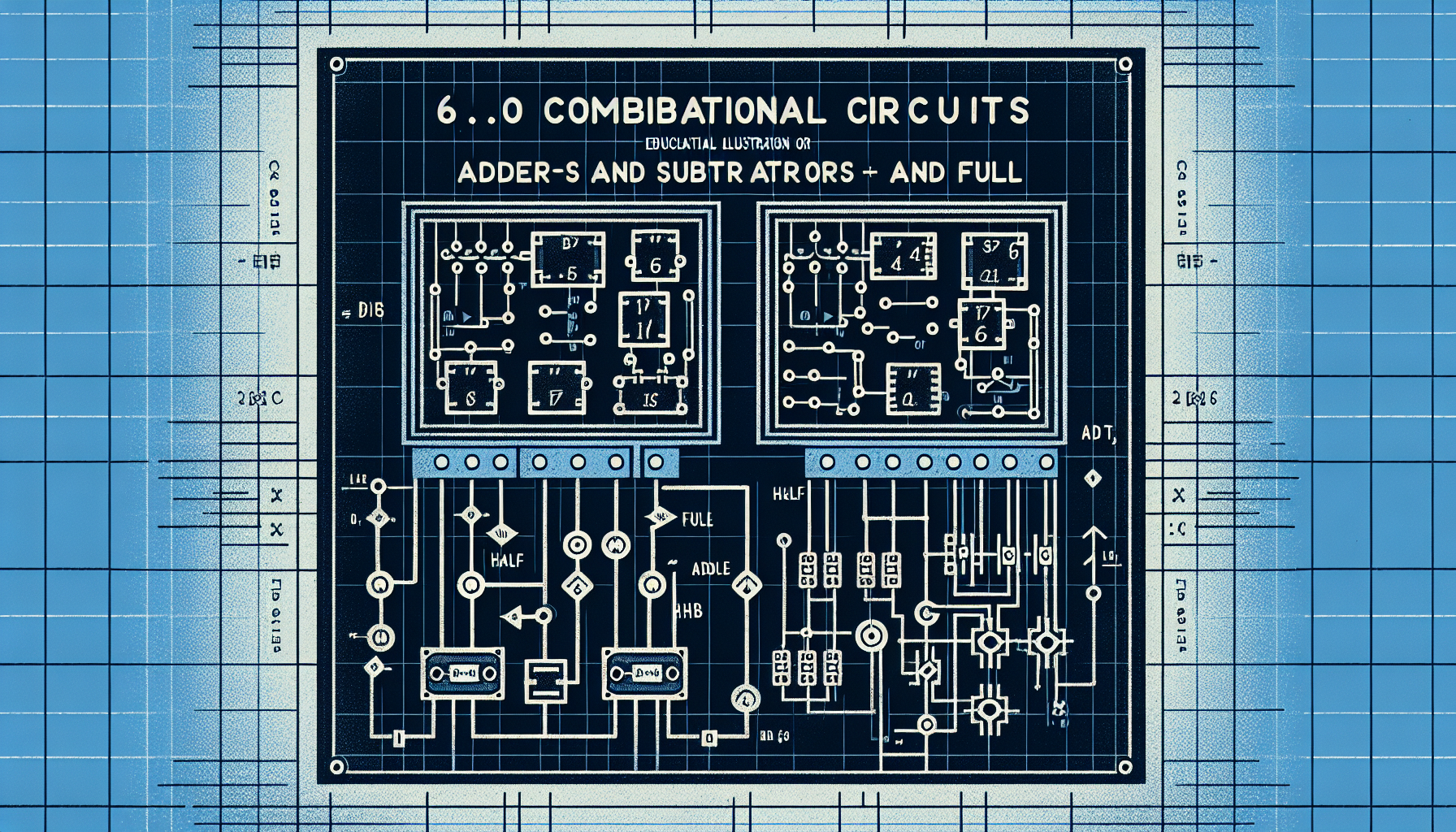

Explore the fundamentals of the digital electronics topic titled “6.0 Combinational Circuits: Adders and Subtractors (Half and Full)”. This subject is fundamental for electronics and helps in understanding electronic systems.
Presented below is an extensive overview:
1. Introduction
Digital electronic systems fundamentally rely on combinational circuits to perform essential arithmetic operations. Among these, adders and subtractors are crucial for enabling basic calculations within various digital devices. These circuits are instrumental in applications ranging from banking automation systems, where transactions and balance calculations depend on efficient arithmetic processing, to embedded systems used in microcontrollers for real-time data management. In the context of IT hardware and digital communication, adders and subtractors form the foundational blocks for more complex arithmetic logic units (ALUs) that process data swiftly and accurately. Understanding how these circuits operate, their design principles, and their applications can significantly enhance one’s grasp of digital system design, preparing students for competitive exams such as the IT Officer and System Officer tests. This chapter delves into the core concepts, types, diagrams, applications, and critical formulas associated with these fundamental circuits.
2. Core Concept
2.1. Half Adder
- Definition: A half adder is a simple combinational circuit that adds two single-bit binary numbers and outputs the sum and carry.
- Working Principles: It takes two inputs, labeled A and B. The sum output (S) is obtained using an XOR gate, and the carry output (C) is obtained using an AND gate.
- Real-life Applications: Half adders are primarily used in building multi-bit adders, such as ripple carry adders, where they combine to handle multiple bits efficiently.
2.2. Full Adder
- Definition: A full adder is a digital circuit that adds three bits — two significant bits and a carry-in from the previous stage — and returns a sum and a carry-out.
- Working Principles: It extends the half adder functionality by incorporating an additional carry-in input. The sum output is derived using XOR gates, and the carry-out involves AND and OR gates to account for all possible carries.
- Real-life Applications: Full adders are essential in constructing multi-bit binary addition systems in arithmetic logic units, enabling precise processing of large binary numbers.
2.3. Subtractors
- Definition: Subtractors are circuits that perform subtraction of binary numbers, with the half and full subtractors designed for single-bit operations.
- Working Principles: They use logic similar to adders but employ functions like XOR and NOT gates to implement the subtraction process. Borrowing mechanisms are used in full subtractors to handle multi-bit subtraction.
- Real-life Applications: Subtractors are used in digital systems for calculations needed in computing algorithms, digital signal processing, and financial transaction modules.
3. Diagrams and Visual Aids
- Truth Tables:<(table border="1">
Inputs Sum / Difference Carry / Borrow A=0, B=0 0 0 A=0, B=1 1 0 A=1, B=0 1 0 A=1, B=1 0 1 - Karnaugh Maps:
For a full adder:
Sum (S):
AB | 00 | 01 | 11 | 10

------------------------

S  |  0 |  1 |  0 |  1
Carry (Cout):
AB | 00 | 01 | 11 | 10

------------------------

Cout | 0 | 0 | 1 | 0 - Circuit Layouts:
       A -----|\

                | XOR ---- Sum (S)

       B -----|/
A -----|\

                | AND ---- Carry (C)

       B -----|/
- Timing Diagrams:
Time --->

Input A:  ----1-----0----1-----...

Input B:  ----0-----1----0-----...

Output (Sum):  ---1-----1-----1--...

Output (Carry): --0-----0-----1--...
- Conversion Charts:
Binary Decimal Hexadecimal 0000 0 0x0 0001 1 0x1 0010 2 0x2 1111 15 0xF
4. Real-World Applications
- Banking systems use adders to calculate balances, interest, and transaction totals.
- Microcontrollers in embedded systems rely on adders and subtractors to perform real-time data processing and control tasks.
- Digital communication systems utilize these circuits in error checking and data encoding schemes.
- Financial calculators and digital meters leverage fast binary addition/subtraction for precise measurements.
- Modern CPUs incorporate complex adder architectures for processing large data sets efficiently.
5. Important Formulas
- Sum of a full adder:
S = A ⊕ B ⊕ C_in - Carry out of a full adder:
C_out = (A AND B) OR (B AND C_in) OR (A AND C_in)
- Difference in a full subtractor:
D = A ⊕ B ⊕ Borrow_in - Borrow out of a full subtractor:
Borrow_out = (NOT A AND B) OR ((B XOR A) AND Borrow_in)
6. MCQs for Practice
Q1. What is the primary function of a half adder?

A. Add two bits  ✔️ Correct

B. Subtract two bits

C. Generate a borrow

D. Perform multiplication
Explanation: It adds two single-bit binary numbers, producing a sum and a carry.
Q2. Which gate is used to generate the sum output in a half adder?

A. AND

B. OR

C. XOR  ✔️ Correct

D. NOT
Explanation: XOR gate outputs the sum in a half adder.
Q3. In a full adder, what additional input is considered compared to a half adder?

A. Carry-in  ✔️ Correct

B. Borrow-in

C. Product

D. Sum
Explanation: Full adders include the carry-in from the previous stage.
Q4. What does a full subtractor subtract?

A. Two bits only

B. Two bits and a borrow-in  ✔️ Correct

C. Multiple bits

D. None of the above
Explanation: It subtracts two bits plus a borrow-in signal.
Q5. Which logic gate is primarily used for calculating the borrow output in a full subtractor?

A. AND

B. NOT

C. OR

D. AND and OR combined  ✔️ Correct
Explanation: The borrow output involves logic AND and OR gates.
Q6. In binary addition, what is the result of adding 1 and 1?

A. 0 with carry 1  ✔️ Correct

B. 1

C. 2

D. 10
Explanation: 1 + 1 in binary equals 0 with a carry of 1.
Q7. What is the main difference between a half and a full adder?

A. The number of inputs

B. The inclusion of a carry-in

C. The ability to handle multiple bits

D. Both A and B  ✔️ Correct
Explanation: Full adders consider an additional carry-in, unlike half adders.
Q8. Which circuit component is essential for creating ripple carry adders?

A. Multiple full adders connected sequentially  ✔️ Correct

B. Multiplexer

C. Flip-flops

D. Shift registers
Explanation: Ripple carry adders cascade full adders to handle multi-bit addition.
Q9. What is the primary purpose of a Karnaugh map?

A. Simplify Boolean expressions  ✔️ Correct

B. Represent timing diagrams

C. Show circuit layouts

D. Generate truth tables
Explanation: Karnaugh maps help in minimizing logic circuits.
Q10. Which application relies on the subtraction capabilities of binary subtractors?

A. Digital thermometers

B. Error correction in data transmission

C. Cash register computations

D. All of the above  ✔️ Correct
Explanation: Subtractors are vital where data needs to be decreased or difference calculated.
7. Frequently Asked Questions (FAQs)
- Q: Why are full adders more commonly used than half adders in digital systems?
A: Because full adders can handle carry-over from previous stages, making them suitable for multi-bit addition. - Q: How do ripple carry adders work?
A: They connect multiple full adders in cascade, passing the carry-out from one as the carry-in to the next. - Q: Can subtractors perform addition?
A: Yes, by using method like two’s complement, subtraction circuits can be adapted to perform addition. - Q: What is the importance of Karnaugh maps in circuit design?
A: They simplify Boolean expressions, leading to simplified and efficient circuit implementations. - Q: Are adder circuits used only in arithmetic operations?
A: No, they are also used in data processing, digital signal processing, and control systems.
8. Summary
- Combinational circuits like adders and subtractors are vital for performing binary arithmetic operations in digital electronics.
- Half adders and full adders serve as basic building blocks for more complex multi-bit adder circuits.
- They are widely used in devices such as CPUs, embedded systems, banking systems, and digital communication hardware.
- Understanding the working principles, logic gate implementation, and designing these circuits is essential for mastering digital system design.
- Visual tools such as truth tables, Karnaugh maps, and timing diagrams aid in designing and analyzing these circuits efficiently.
9. Tags & Keywords
For more detailed study, refer to relevant textbooks,
official technical resources, or trusted educational sites.
Browse more related topics in our [Digital Electronics Archives](https://padhaiguru.in/category/digital-electronics/) for in-depth guides and notes.
Stay updated on digital electronics topics and exam tips using hashtags: #Combinational #Circuits #Adders #Subtractors #Full
Share your thoughts about this topic in the comments below!
—
For further technical reference, see detailed entries on [Digital electronics fundamentals](https://en.wikipedia.org/wiki/Digital_electronics) and [Fundamental logic gate types](https://en.wikipedia.org/wiki/Logic_gate).
