
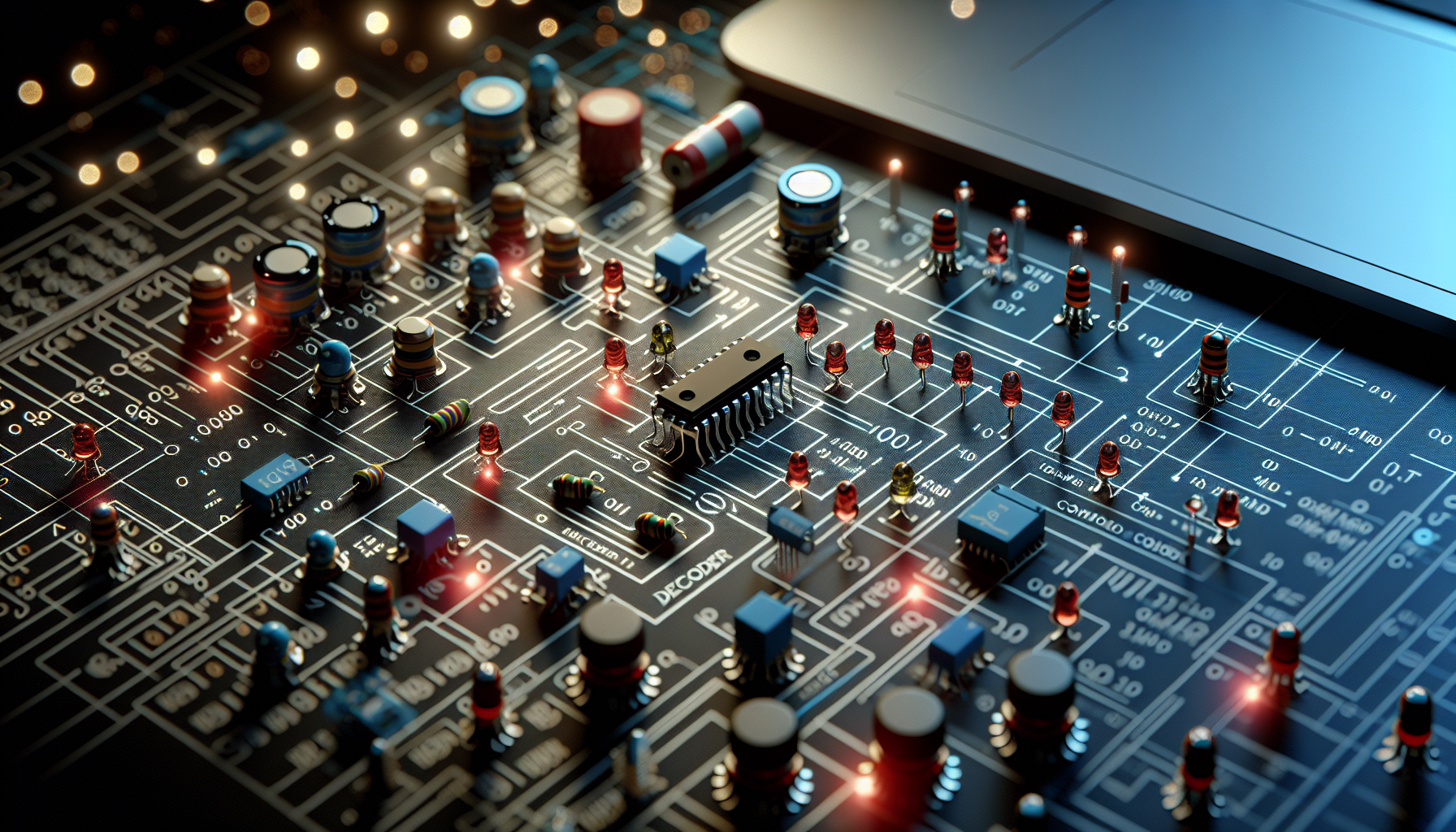

Learn about the basics of the digital electronics topic titled “6.4 Combinational Circuits: Decoders”. This field is vital for technology and helps in developing digital circuits.
The following provides a complete outline:
1. Introduction
Decoders are fundamental building blocks in digital electronics, playing a vital role in converting coded inputs into unique output signals. Their primary function is to decode a binary input signal into a predefined output line, effectively translating data from one form to another for various applications. In the context of modern technology, decoders underpin essential functionalities in systems such as banking automation, embedded systems, communication hardware, and data processing units. For instance, in banking ATMs, decoders help select specific functions based on user inputs, ensuring accurate execution of commands. In embedded systems, they facilitate effective control and selection of peripherals. Understanding decoders within combinational circuits is crucial for designing efficient digital systems, especially in exams for IT Officers and System Officers. Mastery of their working principles enhances one’s ability to analyze, troubleshoot, and develop complex digital architectures essential for modern electronic applications.
2. Core Concept
Subtopic 1: Definition of a Decoder
- Definition: A decoder is a combinational circuit that takes an n-bit binary input and activates exactly one out of 2n outputs simultaneously. It “decodes” the binary input into a one-hot output format, where only one output line is high at any specific input combination.
- Working Principles: Each binary input combination uniquely corresponds to one output line. The decoder uses logic gates to identify the input combination and activate the corresponding output line by setting it high while all others remain low. This process involves applying AND, OR, and NOT gates strategically to generate the desired output based on inputs.
- Real-life Applications: Decoders are essential in digital systems such as microprocessors, memory address decoding, digital multiplexers, and display systems, enabling efficient binary data interpretation and routing.
Subtopic 2: Types of Decoders
- Binary to Decimal Decoder: Converts binary inputs into decimal outputs. For instance, a 3-to-8 decoder interprets 3-bit binary inputs to activate one of 8 outputs.
- N-to-2n> Decoder: Generalized form where ‘n’ input bits produce 2n outputs. For example, a 2-to-4 decoder has 2 inputs and 4 outputs.
- BCD to Decimal Decoder: Converts Binary-Coded Decimal inputs into corresponding decimal signals, often used in digital display systems.
Subtopic 3: Working of a 2-to-4 Decoder
- Working Principles: The 2-to-4 decoder has 2 binary inputs (A and B) and 4 outputs (Y0 to Y3). Using logic gates, the circuit activates only the output corresponding to the binary input combination.
- Truth Table Example:
A B Y0 Y1 Y2 Y3 0 0 1 0 0 0 0 1 0 1 0 0 1 0 0 0 1 0 1 1 0 0 0 1
Subtopic 4: Application of Decoders in Address Decoding
- Definition: Address decoders are used to select specific memory locations or peripherals based on address inputs.
- Working Principles: The binary address is decoded to activate one memory chip or peripheral, enabling proper data routing and system response.
- Real-life Applications: Used in microprocessor memory management, microcontroller I/O operation, and expanding system address spaces.
3. Diagrams and Visual Aids
- Truth Tables: Refer to the 2-to-4 decoder example above.
- Karnaugh Maps: Simplify logic expressions for decoder outputs (see below).
     AB | Y0 Y1 Y2 Y3

    ------------------

     00 | 1  0  0  0

     01 | 0  1  0  0

     10 | 0  0  1  0

     11 | 0  0  0  1
      A -----|>|---\

                         AND gate --- Y0

      B -----|>|---/    AND gate --- Y1

                         AND gate --- Y2

      /> = NOT gate
Input A:  ____||____||____||____

Input B:  __||__||__||__||__

Outputs:

Y0:     1-------0-------0--------0

Y1:     0-------1-------0--------0

Y2:     0-------0-------1--------0

Y3:     0-------0-------0--------1
| Binary | Decimal | Hexadecimal |
|---|---|---|
| 000 | 0 | 0 |
| 001 | 1 | 1 |
| 010 | 2 | 2 |
| 011 | 3 | 3 |
| 100 | 4 | 4 |
| 101 | 5 | 5 |
4. Real-World Applications
- Address decoding in microprocessors and microcontrollers for selecting RAM or I/O ports.
- Display systems like 7-segment displays, where decoders convert binary data into signals controlling the display units.
- Memory management in computers, where decoders select specific memory locations based on address inputs.
- Banking automation systems, such as ATMs, where decoders help in routing commands and data correctly.
- Embedded systems controlling peripheral devices based on binary sensor inputs.
5. Important Formulas
- Logic expression for a 2-to-4 decoder outputs:
Y0 = &overline;A & &overline;B

Y1 = &overline;A & B

Y2 = A & &overline;B

Y3 = A & B
- Binary to decimal conversion:
Decimal = (binary digits combined as base-2 number)
- Number of outputs = 2n
6. MCQs for Practice
Q1. What is the primary function of a decoder?

A. Converting output signals into binary code

B. Encoding data into binary format

C. Converting binary input into a specific output line ✔️ Correct

D. Amplifying input signals
Explanation: A decoder converts binary input signals into a unique output line.
Q2. How many outputs does a 3-to-8 decoder have?

A. 6

B. 8 ✔️ Correct

C. 12

D. 16
Explanation: The number of outputs is 23 = 8.
Q3. Which logic gates are primarily used to build decoders?

A. AND, NOT, OR

B. XOR, NAND

C. AND, OR, NOT ✔️ Correct

D. XOR, NOR
Explanation: Decoders mainly use AND, OR, and NOT gates to decode inputs.
Q4. In a 2-to-4 decoder, when inputs are A=1, B=0, which output is active?

A. Y0

B. Y1

C. Y2 ✔️ Correct

D. Y3
Explanation: When A=1 and B=0, Y2 is active.
Q5. Address decoding is used primarily for what purpose?

A. Encoding data

B. Selecting memory locations or peripherals ✔️ Correct

C. Displaying data on screens

D. Generating power supply voltages
Explanation: Address decoding routes signals to specific memory or peripherals based on input address.
Q6. How many input bits are needed to generate 16 outputs in a decoder?

A. 4 ✔️ Correct

B. 8

C. 16

D. 2
Explanation: 24 = 16, so 4 input bits are needed.
Q7. What is the purpose of a Karnaugh map in the context of decoders?

A. To design circuit layout

B. To simplify logic expressions ✔️ Correct

C. To visualize waveforms

D. To convert binary to hexadecimal
Explanation: Karnaugh maps are used for simplifying logic expressions.
Q8. Which component is NOT directly used in the construction of a decoder?

A. AND gate

B. NOT gate

C. Multiplexer ✔️ Correct

D. OR gate
Explanation: A multiplexer is a different type of circuit, not directly used in decoders.
Q9. A decoder with 3 inputs can activate how many outputs?

A. 4

B. 8 ✔️ Correct

C. 6

D. 16
Explanation: For 3 inputs, 23 = 8 outputs.
Q10. Which statement best describes the operation of a 2-to-4 decoder?

A. It converts 2 decimal inputs into 4 binary outputs.

B. It encodes 4 inputs into 2 outputs.

C. It takes 2 binary inputs and activates one of four outputs.

D. It amplifies an analog signal.


Answer: C


7. Frequently Asked Questions (FAQs)
- Q: Why are decoders important in digital electronics?
A: Decoders are crucial because they allow systems to interpret and route binary data efficiently, enabling proper control and selection of hardware components. - Q: How does a decoder differ from an encoder?
A: A decoder converts binary inputs into a one-hot output, whereas an encoder performs the reverse, converting multiple inputs into a binary code. - Q: What is a common application of a 4-to-16 decoder?
A: It is used in memory address decoding and in microcontroller systems to select specific peripherals or memory locations. - Q: Can decoders be used to implement multiplexers?
A: While related, decoders alone do not implement multiplexers but are often used within multiplexer design for decoding signals. - Q: What are the advantages of using decoders?
A: They provide precise control, simplify complex digital systems, and enable efficient data routing based on binary inputs.
8. Summary
- Decoders are combinational circuits that convert binary input signals into a unique active output line, often called "one-hot" outputs.
- They are essential components in digital electronics, used in address decoding, display systems, and data routing.
- Various types exist, including binary-to-decimal, BCD, and general n-to-2n decoders.
- Their design predominantly relies on AND, OR, and NOT gates, with logic simplification often done using Karnaugh maps.
- Understanding decoders helps in designing efficient digital circuits, crucial for careers in IT, System management, and electronics engineering.
9. Tags & Keywords
digital electronics, 6.4 Combinational Circuits: Decoders, logic gates, binary systems, IT officer exam, system officer, banking automation, electronics notes, circuit design
For more detailed study, refer to relevant textbooks,
official technical resources, or trusted educational sites.
Browse more related topics in our [Digital Electronics Archives](https://padhaiguru.in/category/digital-electronics/) for in-depth guides and notes.
Stay updated on digital electronics topics and exam tips using hashtags: #Combinational #Circuits #Decoders
Feel free to share about this topic in the comments below!
---
For further technical reference, see detailed entries on [Digital electronics fundamentals](https://en.wikipedia.org/wiki/Digital_electronics) and [Fundamental logic gate types](https://en.wikipedia.org/wiki/Logic_gate).
