
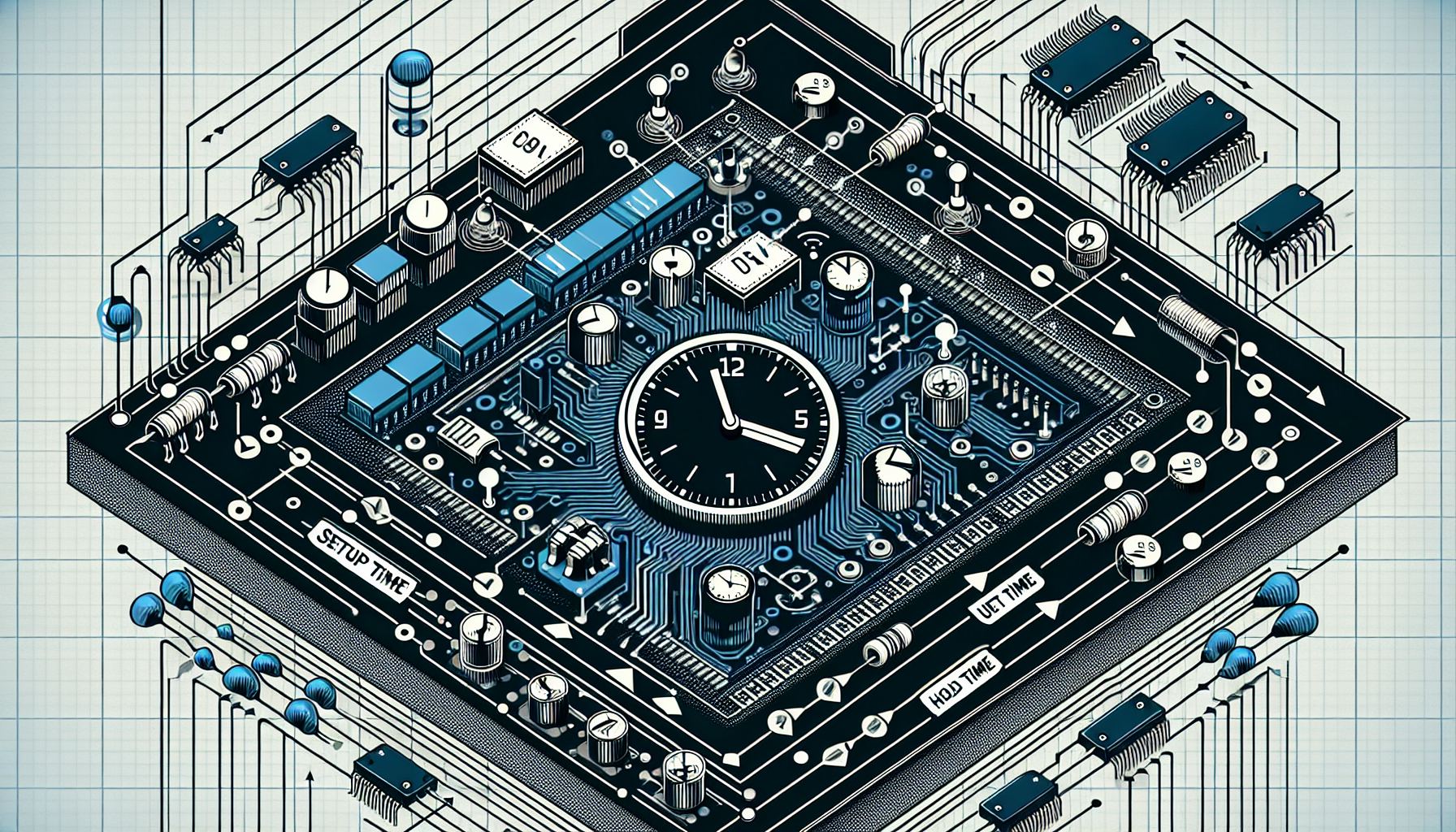

Understand the key concepts of the digital electronics topic titled “8.1 Timing in Digital Circuits: Setup Time and Hold Time”. This subject is important for engineering and helps in understanding digital circuits.
Here you will find a thorough overview:
1. Introduction
Timing analysis is fundamental in digital electronics to ensure reliable operation of sequential circuits. Among various timing parameters, “Setup Time” and “Hold Time” play crucial roles in determining whether data inputs settle correctly before being sampled by flip-flops or registers. Accurate management of these timings ensures data integrity and system stability, which is vital in complex applications such as banking automation systems, embedded controllers, and IT hardware infrastructure. For example, in banking automation, precise timing guarantees that transaction data is correctly latched, preventing errors in financial calculations or record-keeping. Similarly, embedded systems in consumer electronics and industrial automation rely on correct timing sequences to avoid glitches and erroneous outputs. Understanding setup and hold times thus forms the backbone of designing dependable digital systems, making this topic essential for students preparing for roles such as IT Officers, System Officers, and digital electronics engineers.
2. Core Concept
Subheading 1: Definition of Setup Time
- Definition
Setup time is the minimum period that the data signal must be stable before the triggering edge of the clock signal. It ensures that the data captured by the flip-flop during the clock transition is valid and stable.
Working Principles
During a clock cycle, the data input should be held steady for a specific duration prior to the clock’s active edge (either rising or falling). If the data changes too close to this edge or too late, the flip-flop might not sample the correct data, resulting in setup time violation. The setup time is measured from the clock edge backward to the data input’s stable value.
Real-life Applications
- In microcontroller-based embedded systems, ensuring setup time is essential for reliable data transfer between peripherals and CPU registers.
- In bank ATM systems, data integrity relies on proper setup timing during data read/write cycles.
- In high-speed communication interfaces, setup time guarantees proper synchronization between transmitting and receiving devices.
Subheading 2: Definition of Hold Time
- Definition
Hold time is the minimum period after the clock edge during which the data signal must remain unchanged to be correctly captured by a flip-flop. It prevents the data from changing prematurely after being latched.
Working Principles
Once the flip-flop latches data at the clock’s active edge, the data input must be held steady for at least the hold time duration. Violating hold time causes data jitter or metastability, possibly leading to incorrect or unpredictable outputs. Hold time ensures the stability of the data immediately after the clock transition.
Real-life Applications
- In digital communication systems, hold time prevents data corruption during rapid data transfers.
- In complex computing hardware, maintaining hold time ensures synchronization across multiple registers and memory modules.
- In industrial control systems, respect for hold time prevents process errors caused by unstable sensor data readouts.
Subheading 3: Difference between Setup Time and Hold Time
- Definition
Setup time pertains to the period before the clock edge, while hold time refers to the period after the clock edge during which data must remain stable.
- Operational Focus
Setup time ensures data is correctly latched; hold time prevents data from changing prematurely after latching.
- Impact of Violations
Setup time violation leads to metastability during the clock sampling; hold time violation causes data to be corrupted or inconsistent.
Visual Illustration:
(Refer to timing diagrams below to visualize the relationship)
3. Diagrams and Visual Aids
Truth Table for Flip-Flop Timing Constraints
| Parameter | Description |
|---|---|
| Setup Time (Tsetup) | Minimum time before clock edge that data must be stable |
| Hold Time (Thold) | Minimum time after clock edge that data must remain unchanged |
Timing Diagram Example
   Data Input (D):   ____--------____--------____

                  |          |          |

   Clock (CLK):     __/‾\____/‾\____/‾\____

                  |↑     ↑     ↑     ↑     |

   Output (Q):       |     |     |     |     |

                  Data latched at clock rising edge

   Timing constraints:

     - Setup time occurs before the rising edge

     - Hold time occurs after the rising edge
ASCII Circuit Layout
  Data Input (D) ----->| D flip-flop |----> Output (Q)

                    Clock ----->>(CLK)
Conversion Chart: Binary, Decimal, Hex
| Binary | Decimal | Hexadecimal |
|---|---|---|
| 0000 | 0 | 0 |
| 0001 | 1 | 1 |
| 0010 | 2 | 2 |
| 0011 | 3 | 3 |
| 0100 | 4 | 4 |
| 0101 | 5 | 5 |
| 0110 | 6 | 6 |
| 0111 | 7 | 7 |
| 1000 | 8 | 8 |
4. Real-World Applications
- Timing control in ATMs to ensure secure and accurate transaction processing
- Synchronization of data transfers in microcontroller-based embedded systems
- Design of high-speed digital communication protocols such as USB and Ethernet
- Timing management in manufacturing automation systems
- Memory interface design in computer processors to prevent data corruption
5. Important Formulas
- Setup Time:
Tsetup - Hold Time:
Thold
Total Clock-to-Output delay constraints can be represented as:

Tclk + Tsetup ≤ Data Arrival Time

and

Data Stable Time After Clock >= Thold
6. MCQs for Practice
Q1. What does setup time refer to in digital circuits?

A. Time for data to stabilize after clock edge

B. Minimum time data must be stable before clock edge ✔️ Correct

C. Duration for clock signal to reach maximum speed

D. Time required for power stabilization
Explanation: Setup time is the minimum period data must be stable before the clock edge.
Q2. Hold time is the period during which:

A. Data must remain stable after the clock edge ✔️ Correct

B. Data changes before clock edge

C. Power supply remains constant

D. Clock frequency increases
Explanation: Hold time requires data to be held steady immediately after the clock's active edge.
Q3. A violation of setup time causes:

A. Metastability in flip-flops ✔️ Correct

B. Power surge

C. Increased clock speed

D. Data loss in RAM
Explanation: Violating setup time can lead to metastability.
Q4. Which component's timing parameters mainly include setup and hold time?

A. Logic gates

B. Flip-flops ✔️ Correct

C. Resistors

D. Capacitors
Explanation: Setup and hold times are key timing specifications for flip-flops.
Q5. The timing diagram indicates that data must be stable:

A. After the clock edge only

B. Before the clock edge only

C. Both before and after the clock edge ✔️ Correct

D. Neither before nor after the clock edge
Explanation: Data needs to be stable both before (setup) and after (hold) the clock edge.
7. Frequently Asked Questions (FAQs)
- Q: Why are setup and hold times important in digital circuits?
A: They guarantee proper data sampling and prevent metastability, which can cause circuit malfunction. - Q: What happens if setup time is violated?
A: It may lead to incorrect data being latched or system errors due to metastability. - Q: Can hold time violations be ignored in high-speed systems?
A: No, hold time violations are critical even at high speeds and must be managed carefully. - Q: How can one ensure the circuit meets setup and hold time requirements?
A: By proper timing analysis, choosing appropriate clock frequencies, and adding delay buffers if necessary. - Q: Are setup and hold times the same for all flip-flops?
A: No, they vary depending on flip-flop design and manufacturing process.
8. Summary
- Timing in digital circuits involves parameters like setup time and hold time to ensure data integrity during clock operations.
- Proper management of these parameters prevents metastability and data corruption.
- They are critical in high-speed systems, data communication, and embedded system design.
- Understanding timing diagrams, circuit layouts, and applying formulas helps in designing efficient and reliable digital hardware.
- Studying real-world applications emphasizes the importance of timing constraints across electronics and IT sectors.
9. Tags & Keywords
digital electronics, 8.1 Timing in Digital Circuits: Setup Time and Hold Time, logic gates, binary systems, IT officer exam, system officer, banking automation, electronics notes, circuit design
For more detailed study, refer to relevant textbooks,
official technical resources, or trusted educational sites.
Browse more related topics in our [Digital Electronics Archives](https://padhaiguru.in/category/digital-electronics/) for in-depth guides and notes.
Stay updated on digital electronics topics and exam tips using hashtags: #Timing #Digital #Circuits #Setup #Time #Hold #Time
Share your thoughts about this topic in the comments below!
—
For further technical reference, see detailed entries on [Digital electronics fundamentals](https://en.wikipedia.org/wiki/Digital_electronics) and [Fundamental logic gate types](https://en.wikipedia.org/wiki/Logic_gate).
